
Reimagining Class Piano: More Than Just the Next Solo
Students who sign up for Class Piano have a variety of motives for doing so. Some students excel at band or choir or orchestra and are looking for an additional musical outlet. Some are just trying to fulfill a mandatory elective or fill up space on their schedule. Lots of students are in the middle; they have a genuine interest in learning to play piano, but wouldn’t go out of their way to learn if they weren’t required to pick an elective. As music teachers we’re tasked with meeting all of these students where they are regardless of why they’re in the room.
Which begs the question: How on earth are we supposed to do that? How do you design a lesson that challenges the future professional musicians and provides adequate scaffolding for the student who decided they were ‘bad at music’ before they walked into your room? The solution to this conundrum may require that we completely reimagine the way we approach the Piano Lab classroom entirely.
What’s So Wrong With the Status Quo?
Too often we plan piano lessons by looking at the next solo in the traditional method book and using that to guide our lesson planning. And there are all kinds of good reasons we do this! Music teachers are the busiest people I know. Trusting the traditional method book authors and teaching the next song in the book is the easiest, quickest way to plan. And method book authors know what they’re doing, right? They wrote the book after all!
However, what we forget when we do this, is more often than not traditional method book authors were not envisioning our students when they wrote the book. They were envisioning private lesson students who typically start at a young age, and are highly self motivated. They were envisioning a structure in which the student has 30-60 minutes a week with their teacher, then goes home and practices independently on an instrument they own. They were envisioning a private lesson teacher who is not required to fulfil any state standards or follow a prescribed school curriculum.
This is not to say that traditional method books don’t have their place. Many of them have engaging pieces of music and pedagogical methods based on sound research and experience. They’re a great resource! However, when they become the only resource we run the risk of only meeting the needs and goals of the students whose situations most closely align with private lesson students.
Piano as a Vehicle for Musical Exploration and Play
So what should we do instead? Despite the wide variety of differences, our piano students do have a few things in common. Namely, most of your students will tell you they like music! Whether they mean this as a vague concept, a love of performing, or limited to a specific genre, students are interested in music. It’s cool to be interested in music. I have found the most success when I approach piano lab as not necessarily a class in which students learn to play piano songs, but rather a class in which students explore and play with musical ideas and concepts at the piano. The goal is to create a classroom culture of curiosity that allows students to interface with musical ideas and concepts at their level.
As I’m sure you’re already thinking, this is easier said than done! Here are some strategies that I use to accomplish this in my classroom. Maybe some of them will work for you.
Think in Units, Not Songs
Rather than ask “What song should I teach next?” ask “What concept should I teach next?”. Then, plan a unit around that concept that includes a song and other activities. Let’s ask ourselves both of these questions and compare the difference.
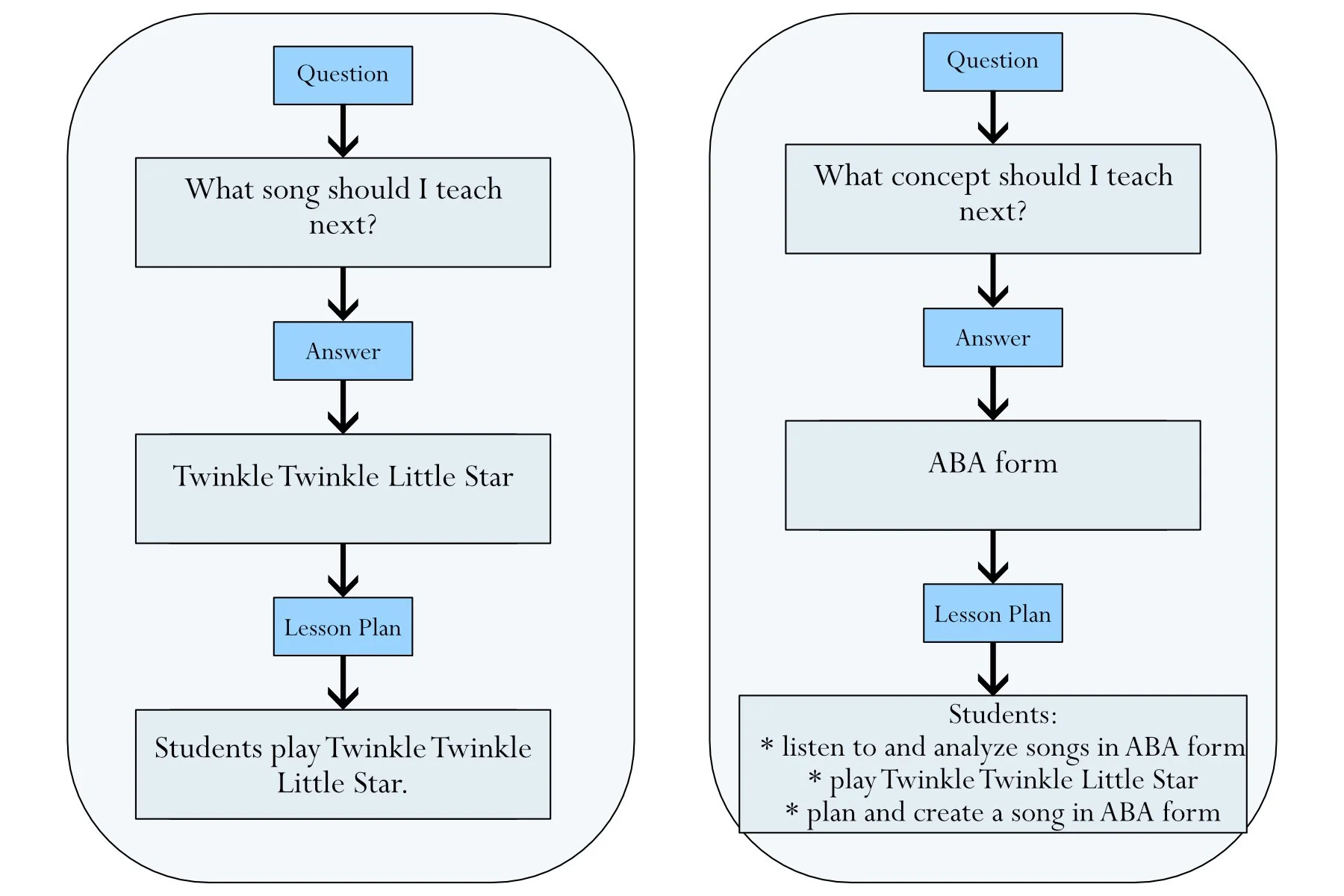
Notice that in both examples, students have the opportunity to play Twinkle Twinkle Little Star. But, when we identify a concept to teach, students are able to interface with the concept in multiple ways. This approach will create a more lasting understanding of the concept, and will allow us to modify our teaching strategies for different students. For example, imagine you have a class of mostly beginners, and one student who has been taking private lessons for five years. In the first example, we would need to assign a different song for that student to learn that would be completely unrelated to what everyone else in the class is doing: playing Twinkle Twinkle Little Star. But in the second lesson, that student could participate in learning the concept with their peers just with a modified lesson. Maybe everyone listens to the same example of ABA form, but the advanced student is given a different listening question to answer. Then, the student is given a more advanced song to play, but their song is also in ABA form. Finally, everyone can plan and create a song in ABA form, but our advanced student includes chords in their composition while everyone else just writes a melody line. In this way, all students can explore and play with ABA form, but on their own level.
Emphasize the Class in ‘Class Piano’
Another way to facilitate musical exploration and play is to create opportunities for students to do so in groups. Including group work in piano class creates a culture of collaboration and is highly motivating for some students. Peer to peer collaboration can be an essential part of play in particular. Think back to games you played as a child. Often the most memorable ones are the games you played with others. Similarly, sharing what you’ve learned after exploration can often solidify the information and spark curiosity in others.
Let’s use our ABA form unit as an example. As part of your listening activity have students think-pair-share. This is a common pedagogical technique in which students think about their answer to a question, then pair with a partner to discuss their answers, and finally share their discussion with the class. Additionally, once students have been given adequate practice time alone, have the entire class perform Twinkle Twinkle Little Star as a whole class piano ensemble. Finally, the ABA composition project could be done in pairs. Students can create both A and B sections together, or each student can claim responsibility for either the A or B sections, combining their work to create a song.
In these examples students have an opportunity to learn and grow from each other.
It is worth mentioning that not every student thrives in group environments. It’s important to have plenty of opportunities for students to work independently. However, piano class in particular already lends itself to independent work. Traditional method books contain mostly solos and are mostly formatted for private lessons. It’s a common class structure for students to plug headphones into keyboards and practice independently for the majority of the class. So in this instance, I will assume that you are already excelling at creating opportunities for independent work.
Musical Exploration and Play in The Piano Laboratory
This idea that piano lab is a class where students explore and play with musical concepts at the piano is the driving force behind The Piano Laboratory. All units are centered around concepts which students explore by listening, playing, responding, and creating. Every unit has both solos and group pieces as well as articles, creative assignments, and listening activities. In short, it is designed for a high school classroom, not a private lesson setting.
And if you want to lesson plan by simply turning the next page in The Piano Laboratory method book? Go ahead! You’ll get units and lessons with a variety of activities that are all engaging, student centered and designed to encourage curiosity and independence.